Radical ambitions, impossible constraints: how Rebuilding Britain Bonds can square the circle of UK fiscal policy
Andy Burnham entered Downing Street with laudable ambitions to end ‘four decades of neoliberalism’.[1] Within his first week in office, he announced a string of retail policy offers to voters worried about making ends meet: removing VAT from domestic electricity bills, capping bus fares and slashing business rates for pubs.[2] To date, Burnham’s poll ratings have been consistently higher than other party leaders’, and support for Labour has recovered from the low levels seen towards the end of Starmer’s premiership.
At the same time, however, there has been little change in the wider economic backdrop. After more than a decade in which the UK could have borrowed cheaply to fund much-needed public investment, it now faces the unenviable task of trying to rebuild public services in a global economic environment characterised by supply constraints and high borrowing costs. Because of catastrophic mismanagement of the public finances during the 2010s, the UK’s public finances are extremely sensitive to increases in interest rates. UK public debt has an unusually short-term maturity profile, due to the lack of fiscal stimulus and public investment over the austerity era. Instead of government borrowing, which could have locked in low interest rates for decades, monetary stimulus had to pick up the economic slack, with quantitative easing converting long-dated gilts into central bank reserves financed at overnight rates.[3] Starving the economy of stimulus also contributed to tepid economic growth, worsening the UK’s already high debt-to-GDP ratio.[4] In essence, the fiscal legacy that Labour inherited means that the UK government now needs to refinance more debt, more often, on increasingly unfavourable terms. If anything, the challenge facing Burnham is even more acute than it was when Starmer left office, as US-Iran hostilities have lasted longer than markets originally anticipated, restricting global energy supplies and pushing interest rates even higher.
But there is no point engaging in the politics of blame unless you can also offer a solution. Ultimately, Starmer’s government failed because it could not find one. Unwilling to break Labour’s manifesto pledge not to increase rates of income tax, VAT and National Insurance on working families, and despite a hefty increase in employers’ National Insurance contributions, much of the additional public investment that the UK desperately needed was funded by increasing public borrowing. Consequently, as the wider economic picture deteriorated, Labour was forced to find small pots of cash that came at a high political cost, in order both to satisfy its fiscal rules and to assuage restive bond markets. Over little more than a year, Labour’s fiscal policy announcements succeeded in penalising pensioners, young people who had taken on a student loan between 2012 and 2023, community pubs, employers, recipients of disability benefit, middle-class professionals saving for their pensions via salary sacrifice schemes, farmers, and many other groups besides. Conventionally, political parties shield key elements of their political coalition from fiscal pain: under Starmer, it became increasingly difficult to discern who the Labour party was actually for, and what the shape of its 2029 electoral coalition could conceivably be.
Burnham’s fiscal bind
In the short-term, better communication and a clearer principled stance on key issues such as Gaza have helped Burnham to rebuild some of Labour’s electoral coalition. Nonetheless, the new Prime Minister is still operating under the same constraints as his predecessor. Worse – he does not have the option of ripping up his manifesto pledges on tax, while blaming the outgoing government for concealing the scale of the problem. Burnham is thus faced with a seemingly impossible choice: find significant spending cuts or tax rises, or else continue with Starmer’s scattergun fiscal policy approach.
In spending terms, while there is scope for savings in the welfare budget in areas such as disability benefits, these savings will require time and additional upfront investment (for example, in mental health services) before they can be realised. Scrapping the state pension triple lock from the end of this Parliament onwards, as Burnham announced at the 2026 Labour Party Conference, should improve the UK’s long-term fiscal outlook; nevertheless, the short-term savings are likely to be minimal, and in any case they have already been earmarked to fund an overhaul of the social care system.
From a tax perspective, Labour’s manifesto pledges on income tax, VAT and National Insurance rule out additional funds from the three revenue streams that generate the most money in the most straightforward manner. Beyond these three taxes, comprehensive reforms to the capital gains tax base and rate could raise significant sums (approaching £20bn), as could an assortment of enhanced charges on income from wealth (in excess of £10bn, if pension wealth were included).[5] Introducing these policies would be contentious, but justifiable nonetheless, both in terms of revenue and in terms of tax equity. Reforms to some of the UK’s largest tax expenditures, such as reducing higher earners’ tax relief on pension contributions, could also raise in excess of £10bn.[6] However, this would penalise working-age households while leaving current pensioners unaffected: effectively hitting Labour’s core vote with tax rises, a demographic that has already borne the brunt of austerity-era fiscal changes. At a more fundamental level, any large tax rises are likely to prove unpopular at this point in the electoral cycle, at a time when taxes are already high by historical standards, and in a context where public, politicians and press conspire to block a more reasoned discussion of the UK’s fiscal predicament.[7]
Repairing Britain Bonds
An alternative is to think outside the conventional fiscal policy box altogether. A broad-based compulsory gilt purchasing scheme could make a valuable contribution towards fixing the public finances – and might be particularly politically attractive to the current Labour government. Under such a scheme, UK taxpayers would be required to put a proportion of their income into longer-dated government-issued bonds (e.g. 15-year gilts), which they would be required to hold for a minimum period (e.g. five years). As with standard UK gilts, these bonds would pay out interest to their owners twice per year. At the end of the minimum retention period, owners would have the option of either continuing to hold their bond (in which case, they would continue to earn interest, as well as receiving the full amount originally invested when the bond matures), or of selling the bond early to other investors. The interest rate on these bonds would be fixed at a level below the government’s current market borrowing costs, meaning that the government would enjoy an increasing large discount on its debt interest expenditure every year.[8]
Figure 1 provides a crude estimate of how these savings might build over time.
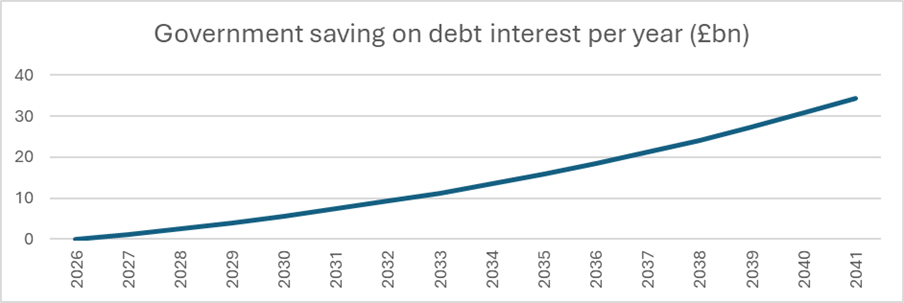
Figure 1. Rebuilding Britain Bonds: Government savings on debt interest expenditure per year (nominal), with 2% annual inflation and 1.5% annual real growth, market interest rates of 5.4% and RBB rates of 1.97% (average of 10-year gilt yield from May 2010 to June 2024). 15-year gilts purchased with 3% of taxable income at basic income tax bracket, 5% at higher/additional brackets.
Politically, these gilts could be presented as funding the remedial public investment needed in the wake of the austerity years: policymakers could emphasise the connection by naming them ‘Rebuilding Britain Bonds’ (RBBs). Moreover, the current Labour government could configure the design of the bonds themselves to serve as a reminder of the fiscal mismanagement of the Conservative years. If the interest rates on RBBs were set at a level equal to the average interest rates at which their post-2010 predecessors could have borrowed (for example, the average 10-year gilt yield from May 2010 to June 2024 was just below 2%), criticisms of the scheme could be met with some variant of the reply: ‘we agree that Conservative governments should have locked-in cheaper market interest rates to rebuild Britain when they were in office, rather than forcing today’s taxpayers to pick up the bill’.
Estimated savings are highly sensitive to the difference between the interest paid on these Repairing Britain Bonds (RBBs) relative to the interest that government would need to pay on similar maturity bonds. However, if the size of this gap were to narrow, any reduction in savings generated by RBBs would be more than offset by wider savings in government debt interest costs. If market interest rates fell below the RBB level, compulsory bond purchases would cease, and owners of RBBs who had held them for longer than the minimum retention period could then sell them at a profit. Conversely, if market interest rates were to increase, the savings would be correspondingly larger. RBBs thus act as a natural hedge against interest rate volatility.
To mitigate distortions, preserve work incentives, build popular consent and incentivise desired behaviours, the government could allow RBB owners to redeem their bonds early (or instantly) to pay for certain kinds of expenditure. For political and incentive reasons, for example, the government might allow graduates to meet their compulsory student loan repayments out of their RBB holdings, so these taxpayers would be essentially unaffected by the policy (assuming the rate of compulsory saving is below the 9% student loan repayment rate). If someone had accumulated RBB savings before starting a university degree (or other government-approved training course), they could pay their tuition upfront using their RBBs. RBBs might also be instantly redeemed to pay for childcare costs, and/or to buy-back child benefit lost to high-income child benefit charges (for those earning more than £60k/year): outgoings that younger voters are more likely to face than their older peers. RBBs could also be redeemed to buy-back the personal allowance currently lost by individuals earning above £100k, providing a way to mitigate the distortionary effect of this high marginal tax-rate. Longer-term, RBBs could be used to move towards a more contributory form of welfare: for example, RBBs might be redeemed early in lieu of unemployment relief, potentially allowing individuals to claim enhanced levels of benefit with less onerous work-seeking requirements.[9]
Political viability and fiscal necessity
Unless Burnham frees up fiscal space as a matter of urgency, his government will be at the mercy of volatile bond markets and geopolitical shocks, which may force him to introduce unpopular spending cuts and tax rises in the run-up to the next general election. RBBs offer a politically-viable solution to the otherwise impossible constraints the new Prime Minister faces. The scheme focuses attention on recent Conservative-led governments’ failure to borrow cheaply for public investment during the demand-deficient 2010s. This generational act of negligence would be underscored in the design of the policy itself, by pegging the below-market interest rates paid on RBBs to the interest rates at which those previous governments could have borrowed. Although RBBs will doubtless be criticised as another form of taxation (and economically some of their effects are similar to a broad-based tax rise), the fact that RBB owners receive regular statements and interest payments, as well as enjoy early-redemption options under certain circumstances, should help to reassure citizen-investors that the money remains theirs.[10] These early-redemption options would also mean that certain groups that already face high marginal tax rates, such as graduates making student loan repayments, would not be required to make any compulsory savings at all: politically, it should be noted that these demographics also constitute important parts of Labour’s electoral coalition.
Fiscally, the incremental but cumulative and compounding savings generated by RBBs should signal to other gilt investors that the UK is serious about improving the long-term sustainability of its public finances. Over time, RBBs will improve the maturity profile of UK public debt, rendering government tax and spending plans less susceptible to short-term economic volatility. From a political economy perspective, RBBs align the interests of voters with a stable, low-inflation, low-interest rate environment, as these conditions will increase the price at which voters can sell their gilts once the minimum holding period finishes. They also offer a solution to another major longer-term problem facing the UK: namely, the winding-down of funded defined-benefit pension schemes, which removes a large captive audience for UK government debt, leaving the public finances increasingly dependent on speculative investors for whom gilts are one option among many.[11]
Prior to becoming Prime Minister, Andy Burnham lamented the fact that UK governments frequently find themselves ‘in hock to the bond markets’.[12] It is true that, given time, investment and fundamental reforms such as devolution, the public sector can become leaner and more efficient, reducing borrowing needs and thus the UK’s dependence on gilt investors. But without additional resources upfront, this rebuilding effort risks stalling before it has really begun. RBBs offer a way of freeing up cash that would otherwise be spent servicing our debts – while simultaneously placing the public finances and public policy in the hands of voters, rather than the bond markets.
Nick O'Donovan is a Senior Lecturer in the Future Economies Research Centre at Manchester Metropolitan University. With a background in public policy, he has worked on questions of taxation, public financial management, economic development and decentralization for organizations including the European Commission and the UK Labour Party, as well as in the context of developing countries and emerging economies.
[1] A. Burnham (2026), First speech as Labour leader, LabourList, 17 July (available at: https://labourlist.org/2026/07/read-andy-burnhams-first-speech-as-labour-leader-in-full/).
[2] B. Chu and T. Edgington (2026), Andy Burnham's first week pledges - how much do they add up to?, BBC News, 24 July (available at: https://www.bbc.co.uk/news/articles/cy078kj0ezyo).
[3] OBR, Fiscal risks and sustainability report, July 2023.
[4] N. O'Donovan (2024), ‘Breaking out’, Renewal 32:2 (available at https://renewal.org.uk/blog/breaking-out/).
[5] A. Advani, H. Hughson, & A. Summers (2026), Taxes at the top: Understanding what high earners pay and options for reform, Centre for the Analysis of Taxation (available at: https://centax.org.uk/wp-content/uploads/2026/09/AdvaniHughsonSummers2026_Taxes-at-the-top.pdf).
[6] S. Adam, I. Delestre, C. Emmerson, & D. Sturrock (2023), A blueprint for a better tax treatment of pensions, Institute for Fiscal Studies (available at: https://ifs.org.uk/sites/default/files/2023-02/A-blueprint-for-a-better-tax-treatment-of-pensions.pdf).
[7] B. Ansell (2026), Taxing times: Policies, politics, and principles, Institute for Public Policy Research (available at: https://files.ippr.org/production/Downloads/Taxing-times-Aug-26.pdf).
[8] A. R. Prest (1969), Compulsory Lending Schemes, International Monetary Fund Staff Papers (16:1), 27-52.
[9] C. Berry & N. O'Donovan (2023), Entrepreneurial egalitarianism: How inequality and insecurity stifle innovation and what we can do about it, UCL Institute for Innovation and Public Purpose (available at: https://discovery.ucl.ac.uk/id/eprint/10196708/1/Berry_berry_c._and_odonovan_n._2023._entrepreneurial_egalitarianism_how_inequality_and_insecurity_stifle_innovation_and_what_we_can_do_about_it.pdf); H. Quilter-Pinner, N. Garland, W. Davies, C. Bick, S. Ropek Hewson, J. Gingrich, & G. Gerstle (2026), What is the left for? The case for a politics of reciprocism, Institute for Public Policy Research (available at: https://files.ippr.org/production/Downloads/What_is_the_left_for_July26.pdf).
[10] Concern that government might renege on its promises was a major reason for Labour scepticism towards Keynes’ proposals for a comparable scheme at the start of World War Two: Labour leaders doubted whether capital interests would follow through on their promises to workers postwar (see R. Toye [1999], Keynes, the Labour Movement, and ‘How to Pay for the War’, Twentieth Century British History 10:3, 255-281). In contrast to Keynes’ scheme, however, RBBs have a definite maturity horizon, and can be redeemed at market value within a relatively short timeframe.
[11] OBR (2025) Fiscal risks and sustainability report July 2025 (available at: https://obr.uk/docs/dlm_uploads/Fiscal-risks-and-sustainability-report-July-2025.pdf).
[12] T. McTague (2025), ‘Andy Burnham’s plan for Britain’, New Statesman, 24 September (available at: https://www.newstatesman.com/politics/2025/09/exclusive-andy-burnhams-plan-for-britain).