Reflections on Labour Party Conference 2026
After Labour Party conference last year, Renewal published a set of reflections from contributors and editors who had attended what would prove to be Keir Starmer's final conference as leader and PM. This year, we have repeated the exercise for the first party conference of the Burnham premiership.
Breathing out
My main reflection, after watching Andy Burnham's first conference speech, came not as a positive assessment of Burnham, but as a negative assessment of Keir Starmer. The speech the former leader gave in the same slot in 2025 was fine, just about; in my post conference Renewal reflection a year ago, I wrote that it was 'a stay of execution not a reprieve' and that overall 'the conference probably went about as well as the leadership could have hoped'.
I feel the last three months, and in particular the conference speech, have allowed me to fully understand the meaning of the phrase 'poverty of low expectations'. With Starmer, one was always reaching for the crumbs, desperately trying to find the points to praise, and that reach was tiring and contorting. He was a bad leader surrounded by unpleasant people who seemingly had little respect or regard for the party he led. He outsourced political thinking to some combination of people who seemingly held the party's actual voters in contempt, and people who think the ideal political praxis is being as horrible as possible.
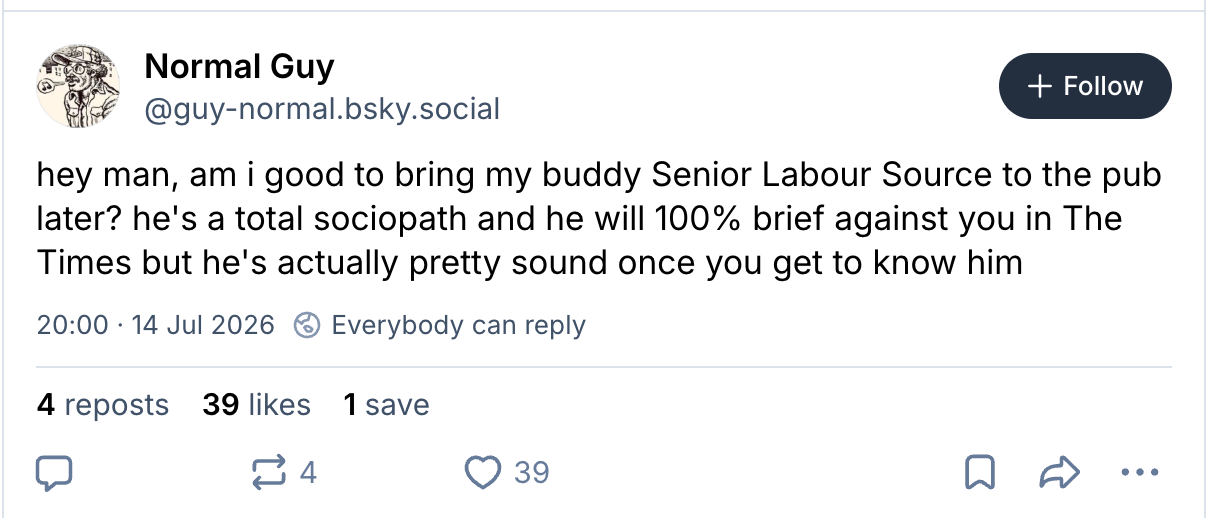
The core text of starmerism
Burnham, and his operation thus far – with a few points of criticism and departure – feels overall like a breath of fresh air. His speech felt like it summed up that changed approach, offering both a positive and likeable presence (so likeable that it dramatically boosted the Labour voting intention of those who watched it) and a serious discussion of social care, among other issues. The conference and the speech left me feeling as though I'd been presented with a kind of negative of Keir Starmer, showing up all the points of lack in clearer relief. Even if intellectually you made all the criticisms, had the tired conversations, put it in the newspaper that he had no friends, litigated and re-litigated, on some fundamental, jaw unclench level, you don't know what you were putting up with 'til it's gone.
Morgan Jones is a co-editor of Renewal
Doing hard things
Last year, Keir Starmer’s speech (which is formatted oddly, like an epic poem, on the Labour Party website) aimed to do two things to preserve his waning influence and boost Labour’s electoral prospects: address the growing threat of Reform and the far right, and remind the public of the government’s plan to deliver growth and better public services. It also reveals the shift, already happening long before Gorton and Denton’s by-election defeat, towards a more self-consciously ‘progressive’ approach to telling the story of the government. There was no need, I imagine people thought, to announce anything new - rather, the speech looked forward to a Labour government that had kept its promises.
Fast forward to a sweltering Hilton Hotel lobby where I am watching Andy Burnham’s speech. He started with thanking Starmer for the majority he now commands. And then he presented a prospectus starkly different from his predecessor. The speech looked forward, in some cases decades into the future, at the kind of country a Labour government could create if given the opportunity and public backing. ‘Taking back control’ of public utilities, local powers to build housing capacity, and cheaper energy bills. Of the three, only VAT off energy bills had a set announcement date - of just 2 days. The rest formed what many criticised Starmer for lacking in his time - a vision.
The set piece announcement concerned the PM’s decades-long mission to finally deliver a National Care Service. What some didn’t expect from a PM often called a ‘people pleaser’ was for a dose of properly brave policy to help fund it. The triple lock, which ratchets up the cost and value of pensions beyond wages, was thought to be untouchable. Burnham proved them wrong. For both this act of bravery and for his ambition to deliver a universal National Care Service, he may yet be punished by the voters. As a Labour member and policy person who cares about care reform, I hope he’s not.
There are hard things coming on top of these big changes which will test his resolve - a plan for youth unemployment, delivering SEN reforms, and improving public services with less fiscal headroom. But triple lock reform showed us the PM can do hard things, when they’re the right thing to do. Starmer thought we beat the far right by delivering good government, but came across as business as usual. Burnham thinks we beat them by fighting - hard - for a different future. The polls, and the conference floor, seem to agree with him.
Abby Jitendra is Policy Director at ThinkLabour
A politics of power
If Labour Conference 2025 was – as writers for this journal reflected this time last year – a battle between the accelerationism of a MAGA-style YIMBY growth agenda and a communitarian focus on power, people and place, I think this year’s Conference made clear which won.
Our new Prime Minister has made community power –an agenda which seeks to push power, wealth and ownership into the hands of people and communities – a key pillar of his approach. It’s something the Co-operative Party has been pushing for some time, through our Community Britain campaign for a state which enables and empowers community-led solutions to the biggest challenges we face, from poverty and radicalisation to climate change and loneliness. This focus was clear not only in Burnham’s speech and the speeches of other key Cabinet members, but also in the tone of most of the events I attended. Never before have the words ‘devolution’, ‘community’ and ‘power’ been uttered by so many public affairs professionals in so many rooms – long may it continue I say!
This renewed politics of power doesn’t come as a surprise. The co-operative movement has its first Co-operative Prime Minister in Andy Burnham, joined by the first Co-operative Deputy Leader in Lucy Powell, first Co-operative General Secretary in Joe Fortune and record numbers of Cabinet members and ministers. I would expect to see co-operative politics spring up in new and unexpected places, as Ministers follow the Prime Minister’s lead in exploring new ways to shift power and ownership away from the few and into the hands of the many.
It also felt more like a labour movement than any Conference I can remember. Last May, I sat at home on my sofa to watch Anthony Albanese’s victory speech, in which he thanked 'the Labor Party’s heart and soul, our rank-and-file members and the mighty trade union movement of Australia'. I remember being taken aback by the ease and pride with which a Prime Minister could speak about the movement that got them there, and wishing it could be replicated so naturally at home. Hearing Andy Burnham’s emotional and heartfelt tribute to a Britain which gave 'trade unions and the co-operative movements to the world' felt like the start of a movement more at ease with itself, understanding of our occasional disagreements but still united by our convictions and proud of what we are.
Caitlin Prowle is Interim General Secretary of the Co-operative Party
Rhetoric matters, movements do too
On stage in Liverpool, Andy Burnham showed that words matter; what you say and how you say it can reshape the political terrain and what feels possible. From the triple lock to our relationship with Europe, Burnham broached conversations that had been deemed too difficult, that other politicians would not touch – this was not a shallow electoral ploy. In doing so he crossed the Rubicon in numerous ways. It is not that he answered exactly what it would mean in each case, only that new possibilities have opened up in each area and both dialogue and contestation can begin. The bounds of politics have expanded because his words created a new political reality.
We must remember that Burnham did similar year ago. As much as many of those now cheering him on mocked him at the time, his move against the leadership at party conference in 2025 set in train events that led to where we are now. He put his head above the parapet and seeded the thought that a change in leadership could happen, and indeed it did.
Burnham must know that whilst his leadership is markedly different, thus far, to what came before, the party itself is largely unchanged. You could see it at conference. Seas of dark suited men in lanyards working for dubious lobbying firms, stilted conversations and an experience adrift not just from the country but the great city of Liverpool itself. For Burnham to enter into real dialogue with the country, Burnham will have to change the party itself too. One man cannot change the country, but they could motivate a movement that can.
The note he ended on signaled this next task when he directly appealed to the public to 'get behind this plan. And get behind each other'. We saw with the ‘community power bus’ the We’re Right Here campaign brought to party conference, that when politics moves closer to civic life a new energy can be found which is antithetical to the corporate lobbyist – more humble, everyday, and relational. That energy is what will be needed to continue the conversation that Burnham started in Liverpool, for there to be a chance that All Together Now, we can believe and hope again.
Josh Westerling is a contributing editor of Renewal
The son of a man who failed his 11-plus
I listened to this year’s speech sat next to a colleague, who reflected on the similarities between his own background and Burnham’s: lives shaped by working-class upbringings in suburban Liverpool but very different paths in the years that followed. We had spoken earlier about the care costs he was shouldering for his elderly parents, and of the experiences in his life which had stripped him of trust in the state.
Burnham is faced with a fairly existential task – not just for the party, but for the country as we want it to be. His job at this year’s conference was to set out a change of course in the middle period of a government which has, thus far, too often been overwhelmed by the challenges it faces; there are harder times and decisions to come, which the speech mostly (and probably appropriately) evaded. Elsewhere at conference, the lack of members – particularly young members – and councillors spoke to the damage done to the fabric of the party in the last few years.
Speaking as someone working in the third sector, it’s very easy to invoke hope and opportunity without really setting out what they mean in practice. Last year, I can’t say I was left with much more than a sense of queasy relief that Starmer had managed to pull his speech off. It’s hard to convince your party of much, let alone the wider electorate, when there is such an obvious ideological void at the heart of your political project, coupled with disdain for many of those who have battled to keep it afloat.
Against this, the line of Burnham’s speech which has stayed in my head over the last couple of weeks is his reference to being the ‘son of a man who failed his 11-plus’. Starmer’s frequent invocation of his own father, the toolmaker, became a grim ritual – a man with a difficult life, carrying out hard work with little reward. But there was never a clear view of what this motivated his son to do or think on an ideological level. For Burnham, a similar reference, more positively framed, was an opportunity to articulate with conviction what a supportive state means materially for those who benefit from it, in a society which values civic ties and sees the benefits of our obligations to one another rather than just the costs. 'Hope again' was a slogan which I initially felt represented a tall order. But – for now – it seems he might manage something of the sort.
Charlotte Sellers is a contributing editor of Renewal
Achieving Roy’s Country
Far more than usual, this Labour conference was defined by the leader’s speech – the opening days by its anticipation, and the closing hours by its afterglow. The speech itself more than delivered: Burnham offered both substantive argument about the state of the country (economy privatised, power centralised, and whole regions deindustrialised), and real policy ambition (a national care service, a new relationship with Europe, and a commission on electoral reform).
For me, the highlight came when Burnham responded to SNP leader John Swinney’s jibe – made on the day Burnham’s father, Roy, had died – that Burnham would be ‘the last Prime Minister of the United Kingdom’. Declaring his intention to prove Swinney wrong, Burnham invoked his father’s life and beliefs to speak movingly about both the United Kingdom of the past and present in which he takes pride (a ‘union of nations’ that stood up to fascism, gave trade unions and cooperatives to world, and lives of dignity and opportunity to its citizens), and the United Kingdom of the future he hopes to build (a country rewired to work for all people and places).
Here, Burnham managed something that Labour leaders since Gordon Brown have typically struggled to do: to express patriotism in a manner that felt sincere and unshowy rather than forced (this was a far cry from the stilted and performative ‘patriotic’ sections of countless Starmer speeches we’ve all now forgotten), and to speak with real feeling about the Union (a fundamental crux of British social democracy, but too often treated as an afterthought, and touched on only formulaically).
In his 1998 book Achieving Our Country, the American philosopher Richard Rorty argued that ‘National pride is to countries what self-respect is to individuals: a necessary condition for self-improvement’. Successful progressive projects, in Rorty’s account, depend on left-wing movements being emotionally involved with their country, and feeling pride in the past, present, and future efforts of their countrymen to improve it.
Social democrats have often struggled to convey that pride. Even when transparently sincere, progressive invocations of patriotism risk clunky nostalgia when overly rooted in the past (Diggers and Chartists anyone?), or cringe-inducing twee when too narrowly-focused on the present (‘that’s real Britain’). What Burnham managed in his speech was to use his father’s life to strike the appropriate prophetic register, channelling a love of his country, a pride in its history, and an ambition for its future into an argument for the kind of United Kingdom he wants to build; into an argument for achieving Roy’s country.
David Klemperer is a co-editor of Renewal
Closing the gap
As countless others have written, this was the best conference speech from a Labour leader in years. Why? It said something substantive about Labour politics, past and present.
By explicitly and undeniably challenging the neoliberal consensus from the party’s mainstream, this was a clear break from recent Labour history. Most importantly, Burnham explained that privatisation was at the root of much of our country’s woes, and linked this to a political attack on his opponents. I’ve wanted to hear the following words for a long time: 'The British Right talk about ‘taking back control’. Never let them forget, they are the ones that gave it away in the first place.'
Yes, the country has been on the wrong track for forty years, but so too has Labour; that for me was the clear subtext of the speech, and why it was a speech that will be remembered. The right might have sold the family silver, but Labour was in power for thirteen years and didn’t get it back. From a former pupil of New Labour, this was bold stuff indeed. Not long ago Labour leaders calling for energy prices to be capped was considered the return of Marx. How times change.
Throughout the speech, and across the conference as a whole, we got a clear sense of a new political economy: public ownership of key strategic assets and utilities; reindustrialisation, backed in a motion on the conference floor; a strategic state working to power the UK’s redevelopment, through patriotic procurement and fewer bureaucratic hurdles. As I’ve written before, unlike previous Labour leaders who felt the need to hedge their critiques of capitalism, there are no such caveats from Burnham. In doing so, he is reviving an Old Labour tradition which has fallen out of fashion in recent decades.
Yet there is a mismatch between words and deeds, between actually existing Burnhamism in office and the rhetoric of the Prime Minister. This is for the simple reason that much of Whitehall and the Labour establishment do not wish to engage in any such labourist revivalism. In many quarters, Old Labour should remain in a sealed tomb; long live New Labour.
Take public ownership. Burnham’s speech rightly argued that public ownership is essential to social democratic statecraft, despite New Labour telling us that what works is all that matters.
But when ministers return to Whitehall after conference recess, they will find a distinctly moderate, reformist policy programme being pursued, leaving the ownership models of our privatised utilities largely intact. Labour’s plan to allow regional mayors oversight of water companies was already proposed by the Starmer government review of the water industry, in which the reviewer was prohibited from examining questions of ownership. Ending the ban on public ownership of water is of course welcome and more ambitious, but doesn’t create a clear path to public ownership.
Burnham needs a Blairite strategy to move his party finally on from New Labour. Despite all the talk of his party being behind him, I also got a sense - as Burnham strode across the conference stage - that he is a man fighting an ideological battle that relatively few of his cadre share. As a result, his vision of political economy will require persuasion and advocating reminiscent of the early days of New Labour, when Blair and Brown fought and fought to win over a sceptical party.
First, he must be what Steve Richards calls a 'political teacher: getting your party to learn hard lessons. This will be relatively easy for Burnham’s other big bets - electoral reform, social care reform, EU relations; such concerns are the bread and butter of the modern Labour Party. But getting his party to fully embrace a nationalist economic agenda of public ownership, reindustrialisation, the rebuilding of UK PLC? Given the genuine sacrifices needed to deliver these aims, this might not be the easiest sell to a graduate-heavy party rooted today in London and the South East.
Second, it will require a constellation of analysts and advisors. As the Centre for Policy Studies and Institute of Economic Affairs were to Thatcherism, and Demos and the IPPR were to Blairism, Burnhamism needs its own people. Of course, much of this new direction in political economy has been seeded from the policy world, not least Mat Lawrence of Common Wealth’s definitive work on the Productive State, and the many IPPR and Think Labour alumni serving in government. But there remains some way to go until the virtuous cycle of thinkers and doers is formed around Burnham’s political economy. One place to start is working with the newly formed Reindustrialisation Research Group in the Parliamentary Labour Party.
Third, it will require a voter base. If Thatcher had Essex Man and Blair Worcester Woman, what is Burnham’s equivalent? Much of the centre-left has persuaded itself that all it needs to do is unite the ‘progressive vote’ at the next election. But is this alliance of socially liberal voters, with very different material economic interests, the right one for delivering public ownership and reindustrialisation? At the very least it will require winning over the former industrial heartlands that gained the least from neoliberalism and stand to gain the most from a new economic order.
Perhaps the greatest irony of them all is that if there is anyone that can move the party on from New Labour, it’s someone who was schooled in its methods. Someone who learnt the ropes the old way, but is willing to take Labour’s politics in a new direction. As politics returns to reality after a conference high, and we look towards the Budget, 10-Year Plan and Spending Review, it’s up to Burnham to deliver this. That demands closing the gap between him and the country, and between his words and his government’s agenda. This must be the mantra now - day in, day out.
Ben Glover is a contributing editor of Renewal